

5 Natural Ways to Improve Skin Texture and Reveal Smoother Skin
Last Updated: October 25, 2026
Quick Summary
To improve skin texture naturally, start with gentle cleansing and chemical exfoliation 1-2 times per week, then layer hydrating serums and moisturizers to support your skin barrier. Add targeted ingredients like retinol for cell turnover and vitamin C for radiance, and protect with daily SPF 30 sunscreen to prevent new damage.
- Double cleanse with an oil-based cleanser followed by a water-based cleanser to remove impurities without stripping natural oils.
- Use chemical exfoliation with glycolic or lactic acid 1-2 times per week, never more than 3-4 times weekly, to avoid damaging your skin barrier.
- Apply retinol 1-2 times per week initially to speed cell turnover and boost collagen production for smoother skin.
- Expect visible texture improvements within 3-4 weeks of consistent routine use, with the most dramatic transformation appearing after 3-6 months.
- Wear broad-spectrum SPF 30 sunscreen daily and reapply every two hours outdoors to prevent UV damage that worsens texture.
Table of Contents
- Identify the Root Cause of Your Uneven Skin Texture
- Step 1: Start with Gentle Cleansing and Double Cleansing
- Step 2: How to Exfoliate Skin Gently Without Over-Treating
- Step 3: Build a Skincare Routine for Dry, Dull Skin
- Step 4: Use Targeted Ingredients to Refine Texture and Tone
- Step 5: Protect and Support with Daily Sunscreen and Healthy Habits
- How Long It Takes to Improve Skin Texture Naturally
- When to Seek Professional Care for Persistent Texture Issues
- Frequently Asked Questions
Identify the Root Cause of Your Uneven Skin Texture
Rough, bumpy skin builds gradually, often from multiple causes.
Dryness is a common culprit. When skin lacks moisture, dead skin cells pile up instead of shedding smoothly, creating a sandpaper-like feel that makes texture more visible.
Sun damage accelerates texture problems. UV exposure breaks down collagen and elastin, showing up over time as rough patches, fine lines, and loss of smoothness, and it compounds year after year without protection (A Comprehensive Review of the Role of UV Radiation in Photoaging Processes Between...).
Harsh products also worsen texture. Over-exfoliating, irritating cleansers, or too many actives at once damage the skin barrier, leaving it inflamed, dry, and textured.
Age-related changes shift how skin behaves.
Before investing in any treatment, identify your primary issue, dehydration, sun damage, or over-treatment. The answer shapes your entire approach. Why Is My Skin Dull and Dry? Causes and Fixes explores these root causes in depth.
Step 1: Start with Gentle Cleansing and Double Cleansing
Your cleansing routine sets the foundation.
Double cleansing transforms results: first an oil-based cleanser to dissolve makeup and sebum, then a water-based cleanser to remove remaining residue.
Here's the process:
- Apply an oil-based cleanser to dry skin and massage gently for 30 seconds
- Add a small amount of water to emulsify the oil into a milky texture
- Rinse thoroughly with lukewarm water
The Hydrating Facial Cleanser is designed for this purpose. Its silky formula preserves hydration while cleansing, which is crucial for texture improvement.
Massage gently during cleansing. Rough scrubbing irritates skin and worsens texture. Use your fingertips and move in circular motions.
Step 2: How to Exfoliate Skin Gently Without Over-Treating
Exfoliation is essential for improving skin texture naturally, removing dead cells that make skin dull and rough. But exfoliate wrong and you'll damage your barrier and make texture worse.
Chemical exfoliation is gentler than physical scrubbing. It uses acids to dissolve the bonds between dead skin cells so they shed without manual friction, the approach that works best for texture.
Chemical exfoliation with glycolic acid and lactic acid
Glycolic acid is an alpha hydroxy acid (AHA) that penetrates the skin and dissolves dead cells. It's effective but also stronger. Start with lower concentrations and use it just 1-2 times per week.
Lactic acid is a milder AHA derived from milk. It exfoliates gently while also hydrating. It's ideal if your skin is sensitive or very dry. You can often use it more frequently than glycolic acid.
Frequency and tolerance for sensitive skin
This is where most people go wrong. They exfoliate too often and damage their skin barrier.
Start with once per week. If tolerated after two weeks, increase to twice per week.
Watch for signs of over-exfoliation:
- Increased redness or irritation
- Tightness or dryness that won't improve with moisturizer
- Sensitivity to other products
If you notice these, pull back to once per week or skip exfoliation for a few days to let your barrier repair.
For very sensitive skin, start with low-concentration lactic acid once per week and increase later if needed.
Step 3: Build a Skincare Routine for Dry, Dull Skin
A solid routine layers products in the right order so each absorbs properly. The goal is hydration, nourishment, and barrier support.
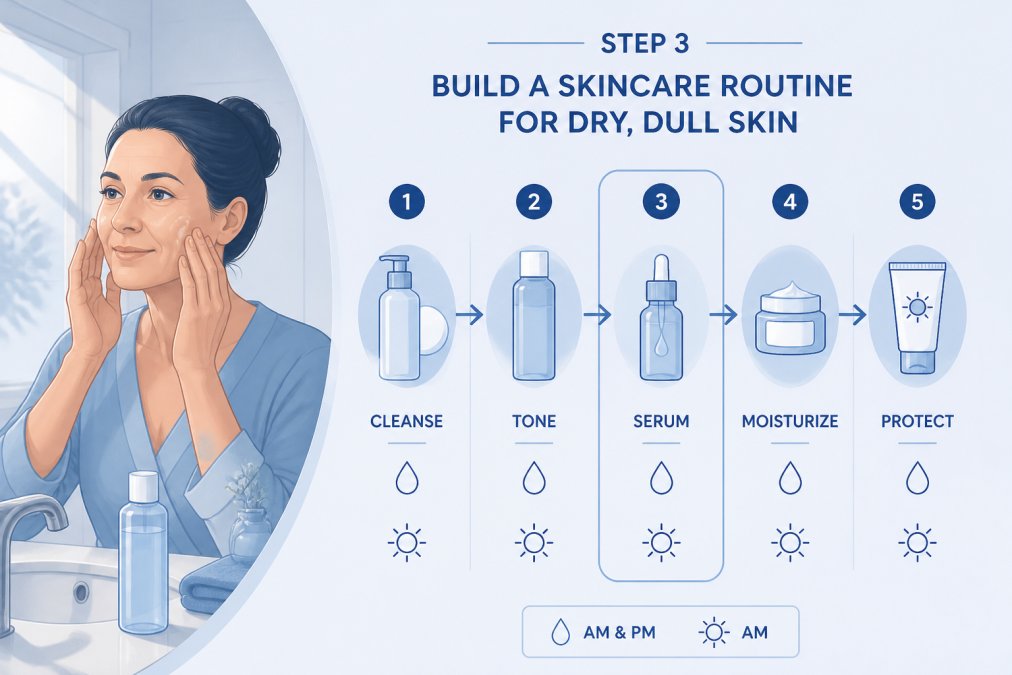
Here's the order that works best:
- Cleanse with a gentle cleanser (as covered above)
- Tone with a lightweight toner to refresh and prepare skin
- Treat with serums and targeted ingredients
- Moisturize with a nourishing cream or serum
- Protect with sunscreen during the day (or skip this step at night)
Hydration, moisturizing, and supporting the skin barrier
Hydration means adding water to the skin. Hydrating products contain humectants like glycerin that draw moisture in; they feel light and absorb quickly.
Moisturizing means sealing in that hydration with an occlusive layer. Moisturizers contain oils and butters that prevent water from evaporating; they feel richer and sit on the skin longer.
Supporting the barrier means using ingredients that repair the skin's protective layer. Ceramides, fatty acids, and peptides help rebuild a damaged barrier.
Layering serums and treatments for maximum absorption
The order matters. Apply products from thinnest to thickest consistency.
- Toner (watery)
- Essence (slightly thicker)
- Serum (silky)
Wait 30-60 seconds between steps so each product absorbs, preventing pilling and ensuring penetration.
The Niacinamide Vitamin Boost Serum fits beautifully into this routine. Apply it after your toner and before your moisturizer. It brightens dull skin while supporting your barrier. Niacinamide helps improve uneven tone, while vitamin C provides antioxidant protection.
Step 4: Use Targeted Ingredients to Refine Texture and Tone
Beyond cleansing and exfoliation, specific ingredients accelerate texture improvement. They work on different levels: some boost cell turnover, others repair sun damage, others support hydration.
Retinol and retinoids for cell turnover and fine lines
Retinol is vitamin A converted into a form skin can use (Retinoids: active molecules influencing skin structure formation in cosmetic and...).
Retinol also boosts collagen production. Over weeks and months, this firms skin and softens fine lines.
Start low and go slow with retinol. Use it 1-2 times per week initially.
Avoid using retinol with other exfoliating acids on the same night.
The Night Renewal Crème contains Retinyl Palmitate, a gentler form of retinol, plus Glycolic Acid for exfoliation.
Vitamin C and antioxidants for radiance and sun damage repair
Vitamin C is a powerful antioxidant that brightens dull skin and repairs sun damage.
Vitamin C also supports collagen synthesis, which improves skin firmness and smoothness.
Antioxidants like vitamin E, green tea extract, and resveratrol work alongside vitamin C. They protect skin from environmental damage and reduce inflammation.
Apply vitamin C serums in the morning after cleansing and toning. Follow with moisturizer and sunscreen.
Step 5: Protect and Support with Daily Sunscreen and Healthy Habits
Sunscreen is non-negotiable for texture improvement. UV damage accelerates aging and creates rough, uneven texture.
Use a broad-spectrum sunscreen with at least SPF 30 (the WHO). Apply it every single day, even on cloudy days.
Beyond sunscreen, lifestyle habits matter:
- Stay hydrated. Drink enough water throughout the day. Skin hydration starts from within.
- Eat antioxidant-rich foods. Berries, leafy greens, and green tea protect skin from oxidative stress.
- Sleep enough. Skin repairs itself during sleep. Aim for 7-9 hours per night.
These habits amplify the results of your skincare routine. Skincare alone can only do so much if the rest of your lifestyle is working against you.
How Long It Takes to Improve Skin Texture Naturally
This is the question everyone asks, and the honest answer is: it depends. But there are realistic timelines to expect.
Realistic timelines for visible smoothing and tone improvement
Weeks 1-2: You'll notice skin feels softer and smoother to the touch.
Weeks 3-4: Visible improvements appear. Texture becomes noticeably smoother. Fine lines look less pronounced.
Weeks 5-8: Deeper improvements emerge. If you're using retinol, collagen production increases and firmness improves.
Weeks 8-12: Long-term changes solidify. Skin texture continues to refine.
3-6 months: This is when you see the most dramatic transformation. Cell turnover has cycled multiple times. Collagen remodeling shows real results. Texture improvements are stable and sustained.
These timelines assume consistent use of your routine. Skipping steps or using products inconsistently extends the timeline.
Tracking progress and knowing when to adjust your routine
Take a photo of your skin in natural light at the start. Take another every two weeks.
Pay attention to how your skin feels, not just how it looks.
If you're not seeing improvement after 8 weeks, something needs to change. Common reasons include:
- You're exfoliating too often and damaging your barrier
- Your moisturizer isn't hydrating enough for your climate or skin type
- You're not using sunscreen, so new damage is canceling out improvements
Adjust one variable at a time. If you suspect over-exfoliation, pull back to once per week for two weeks.
How Long to See Skincare Results: A Timeline provides a more detailed breakdown of what to expect month by month, including how different ingredients affect your timeline.
Here's what to expect as your skin texture improves with consistent home care.
| Timeline | What to Expect |
|---|---|
| Weeks 1-2 | Skin feels softer and smoother; dullness may start to lift |
| Weeks 3-4 | Texture noticeably smoother; fine lines less pronounced |
| Weeks 5-8 | Deeper improvements; collagen production increases; pores appear smaller |
| Weeks 8-12 | Long-term changes solidify; texture continues to refine |
| 3-6 months | Most dramatic transformation; cell turnover cycled multiple times |
When to Seek Professional Care for Persistent Texture Issues
Home skincare addresses most texture concerns. But some situations benefit from professional treatments.
Consider professional care if:
- Your texture hasn't improved after 12 weeks of consistent effort
- Your texture is accompanied by severe acne or persistent inflammation
- You have deep acne scars that create permanent indentations
Professional options include microneedling, chemical peels, and laser treatments. These work by stimulating collagen production or removing damaged skin layers more aggressively than home treatments can.
Home care and professional treatments work well together. Maintain your routine even if you pursue professional options.
Improving skin texture naturally takes consistency and patience, but the results are worth it.
Frequently Asked Questions
How long does it realistically take to see smoother-looking skin?
Most people notice visible improvement in skin texture within 4 to 8 weeks of consistent use of exfoliating and hydrating products. Cell turnover takes approximately 28 days, so patience is essential. For fine lines and deeper texture concerns, 12 weeks of regular application of retinoids or vitamin C may be needed. Tracking progress with photos every 2 weeks helps you see subtle changes your eye might miss. Results depend on starting texture severity, product consistency, and whether you're addressing the underlying cause (dryness, sun damage, or clogged pores).
What's the difference between how to improve uneven skin texture naturally and using professional treatments?
Natural approaches using gentle exfoliation, hydration, and targeted ingredients work gradually by supporting your skin's own renewal cycle and barrier health. Professional treatments like microneedling or chemical peels accelerate cell turnover and collagen remodeling more rapidly but carry higher cost and recovery time. For most people with mild to moderate texture concerns, a consistent routine with chemical exfoliants like glycolic acid, retinol, and nourishing hydration delivers meaningful results without downtime. Professional care becomes relevant when texture is severe, scarring is present, or natural methods plateau after 3 months of dedicated use.
Can dry skin make texture look worse?
Yes. Dehydrated skin shows texture more prominently because dryness emphasizes fine lines, flakes, and uneven surface. Dead skin cells accumulate on dry skin, making it look dull and rough. When your skin barrier is compromised, moisture escapes, triggering more visible texture and sometimes irritation. This is why hydration and barrier support are foundational to improving texture naturally. Using a hydrating cleanser, toner with glycerin and panthenol, and a moisturizer with squalane and vitamin E helps plump the skin and smooth texture within days. Addressing dryness first often reveals that some texture concerns were simply dehydration, not permanent damage.
Which natural ingredients are most effective for improving skin texture?
Glycolic acid and lactic acid chemically exfoliate to remove dead skin cells and accelerate cell turnover, smoothing texture within weeks. Retinol and retinyl palmitate support skin renewal and soften the appearance of fine lines. Vitamin C brightens and repairs sun damage that contributes to rough texture, while niacinamide helps refine pores and improve uneven tone. Squalane, panthenol, and vitamin E hydrate and support the skin barrier, making texture appear smoother. Antioxidants like white tea extract defend against environmental stressors that degrade skin quality. The most effective approach combines gentle exfoliation with hydration and barrier support rather than relying on a single ingredient.
