

Best Vegan Skincare for Mature Skin
Table of Contents
- Why Vegan Skincare Works for Mature Skin
- Key Plant-Based Skincare Ingredients for Mature Skin
- Best Vegan Anti-Wrinkle Serum: Niacinamide Vitamin Boost
- Best Vegan Night Cream for Mature Skin: Night Renewal Crème
- Building Your Vegan Skincare Routine for Mature Skin
- How to Verify Vegan and Cruelty-Free Claims
- Frequently Asked Questions
Last Updated: October 16, 2026
Why Vegan Skincare Works for Mature Skin
Vegan skincare formulas deliver targeted hydration and nourishment without animal-derived ingredients, making them effective for mature skin concerns. Plant-based formulations often contain active botanicals and antioxidants, addressing dryness, loss of elasticity, fine lines, and uneven tone.
The shift toward vegan skincare isn't just ethical, it's a performance choice. Plant-based oils, botanical extracts, and vegan collagen alternatives deliver moisture and support renewal without the heaviness or irritation of traditional anti-aging products.
What makes this approach work is the ingredient profile. Vegan formulas rely on concentrated plant compounds, rosehip oil, niacinamide, retinyl palmitate, glycolic acid, that penetrate effectively and support the skin barrier.
Key Plant-Based Skincare Ingredients for Mature Skin
Most roundups list the same six or seven ingredients and stop there. What helps mature skin is knowing which ingredients have real research behind them, what they can and cannot do, how long they take to work, and how they interact.
First, what "mature skin" actually means
Mature skin is not a single skin type but a stage, usually starting in the mid-30s to early 40s and continuing through menopause and beyond, during which several changes stack up:
- Reduced sebum and lipid production, which makes skin feel drier and less cushioned.
- Slower cell turnover, which shows up as dullness, rough texture, and a less even-looking tone.
- Thinning of the epidermis and reduced collagen and elastin support, which contributes to the appearance of fine lines and a loss of firmness.
- A more reactive barrier, meaning ingredients that were fine at 25 can sting or flush at 50.
Because these changes happen at different speeds, the right ingredient mix depends on what you're actually seeing. A 45-year-old with oily, breakout-prone skin and a 60-year-old with very dry skin need different formulas, even though both fall under "mature skin."
Ingredients with the strongest research backing
These are the ones most dermatology sources and formulators agree on: not miracle workers, but with a plausible mechanism and reasonable evidence.
Niacinamide (vitamin B3). Supports the skin barrier, reduces moisture loss, and improves uneven tone and redness.
Vitamin C (L-ascorbic acid and gentler derivatives). An antioxidant that defends against environmental stress and gradually improves dullness and uneven tone.
Retinoids, including vegan-friendly alternatives. Retinol and its esters (like retinyl palmitate) are the most evidence-backed actives for fine lines and texture.
Alpha-hydroxy acids (glycolic and lactic acid). These exfoliate by loosening bonds between dead surface cells, improving texture and uneven tone.
Ingredients with real but more modest evidence
These are worth using, but the marketing usually outruns the science.
Squalane. A lightweight emollient that mimics skin's own sebum. Stable, non-comedogenic for most people, and layers well under heavier creams, a comfort and barrier ingredient, not an active.
Peptides. Short amino acid chains that may support the skin's own renewal signals. Research is real but mixed, and results depend on which peptide and at what concentration.
Vitamin E (tocopherol). An antioxidant that works well alongside vitamin C. On its own, its visible effects are limited.
What these ingredients cannot do
Realistic expectations matter more than an ingredient list. No topical vegan skincare product will:
- Replace lost volume or reverse structural aging.
- Match the effect of in-office procedures like lasers or fillers.
- Produce visible change in under two weeks, except for hydration-related plumpness.
- Work if you are not using daily sunscreen, because UV exposure undoes most of the benefit.
Most actives need 8-12 weeks of consistent use before you judge results, except humectants, which show up fast but fade fast.
How to layer them without irritating mature skin
A few rules prevent most problems:
- Do not stack strong actives on the same night. If you use an AHA, skip the retinoid that evening.
- Alternate nights when introducing either one, and increase frequency only if skin stays calm.
- Apply humectants to damp skin, then seal with an emollient or cream.
- Antioxidants in the morning, renewal actives at night. Vitamin C pairs well with sunscreen during the day; retinoids and AHAs are better tolerated overnight.
- Patch test any new active on the inner forearm or behind the ear for 3-5 nights before using it on the face.
Best Vegan Anti-Wrinkle Serum: Niacinamide Vitamin Boost
A lightweight serum is the foundation of any anti-wrinkle routine because serums deliver concentrated actives directly to skin. The Niacinamide Vitamin Boost Serum from Liv Beauty combines three brightening, renewal-supporting actives chosen for mature skin: niacinamide, Vitamin C, and Vitamin B5.

This serum addresses mature skin's core concerns. Niacinamide improves uneven tone while supporting the moisture barrier, critical because mature skin often struggles with dryness and sensitivity. Vitamin C enhances radiance and provides antioxidant defense.
The formula absorbs effortlessly without heaviness, layering beautifully into your ritual. Apply a few drops after cleansing and toning, then follow with a facial oil and moisturizer to seal in hydration.
At $79, this serum addresses multiple concerns at once: brightening dullness, supporting moisture, and refining uneven tone.
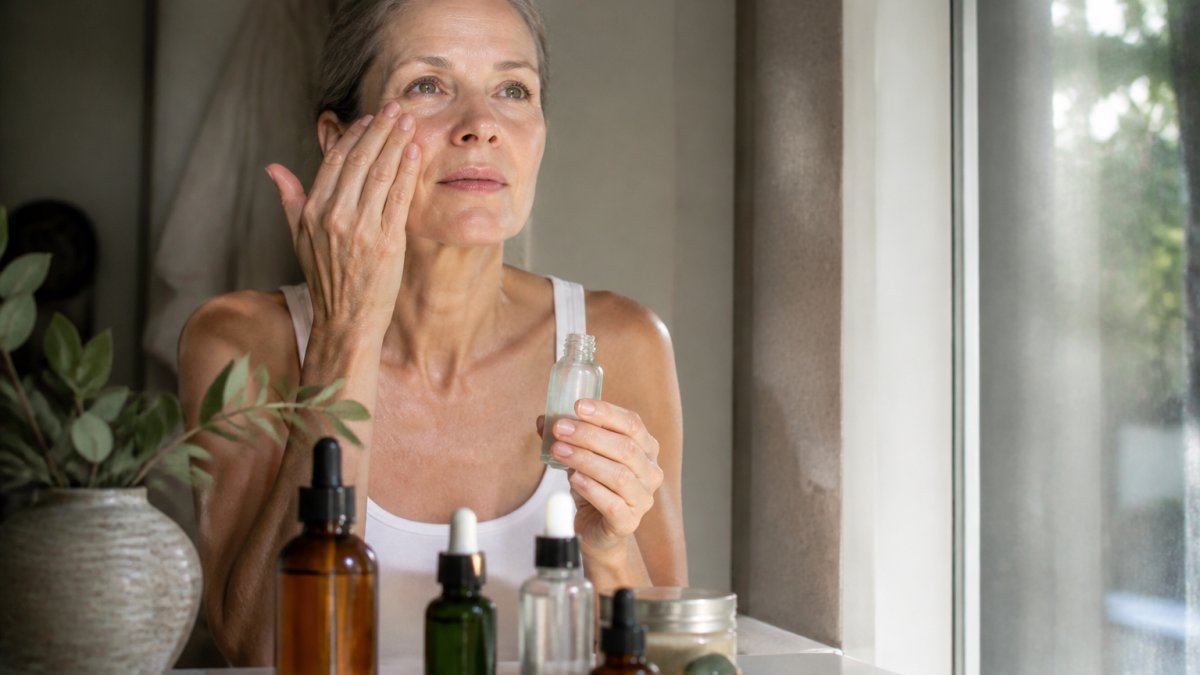
Best Vegan Night Cream for Mature Skin: Night Renewal Crème
Night is when skin's renewal cycle peaks, making it ideal for intensive treatment. The Night Renewal Crème from Liv Beauty works in harmony with this cycle, combining gentle exfoliation with deep replenishment.

Glycolic acid gently exfoliates to improve texture and uneven tone, concerns that define mature skin. Retinyl palmitate supports renewal and softens the appearance of fine lines.
The formula is rich but absorbs fully without feeling heavy. Apply a small amount over face and neck as your final evening step.
At $78, this night cream offers gentle exfoliation and intensive hydration. By morning, skin feels softer, smoother, and deeply replenished with a fresh, luminous look.
Building Your Vegan Skincare Routine for Mature Skin
A complete vegan skincare routine for mature skin follows a simple sequence: cleanse, tone, treat, nourish, and renew.
Cleanse first with a hydrating formula that removes impurities without stripping moisture.
Tone second to refresh and rebalance. The Mild Toning Elixir removes lingering impurities and prepares skin for what follows.
Treat with a serum to deliver concentrated actives.
Nourish with a facial oil to seal in moisture and add luminosity. The Rose Gold Oil from Liv Beauty is rich in rosehip oil, omega fatty acids, and antioxidants.

Renew at night with an intensive treatment. The Night Renewal Crème combines gentle exfoliation with deep replenishment, so skin wakes refined and radiant.
Step |
Product |
Key Benefit |
Frequency |
|---|---|---|---|
Cleanse |
Hydrating Facial Cleanser |
Removes impurities while maintaining hydration |
Morning & evening |
Tone |
Mild Toning Elixir |
Refreshes and prepares skin for treatments |
Morning & evening |
Treat |
Niacinamide Vitamin Boost Serum |
Brightens, supports hydration, improves tone |
Daily |
Nourish |
Rose Gold Oil |
Seals moisture, adds luminosity |
As needed |
Renew |
Night Renewal Crème |
Exfoliates gently, deeply replenishes |
2-3x weekly to nightly |
This routine addresses the core concerns of best vegan skincare for mature skin: hydration, brightness, firmness, and refined texture.
How to Verify Vegan and Cruelty-Free Claims
"Vegan," "cruelty-free," and "organic" are three different claims, and most roundups treat them as if they mean the same thing. They don't. Understanding the difference is the fastest way to spot greenwashing and choose products that match your values.
What each label actually means
Vegan refers to ingredients. A vegan product contains no animal-derived ingredients: no beeswax, lanolin, carmine, collagen, gelatin, honey, milk, or shellac. It says nothing about animal testing.
Cruelty-free refers to testing. A cruelty-free product was not tested on animals at any stage, by the brand or its suppliers. It says nothing about whether ingredients are animal-derived; a product can be cruelty-free and still contain beeswax or lanolin.
Organic refers to how ingredients were farmed. It says nothing about animal testing or animal-derived ingredients. A product can be certified organic and still contain honey or beeswax.
A product can be any combination of these.
How to verify each claim
For vegan claims:
- Look for third-party certification from the Vegan Society (Vegan Trademark) or PETA (Beauty Without Bunnies). These require supply-chain documentation, not just a self-declaration.
- Without certification, read the full INCI list for animal-derived ingredients: beeswax (Cera alba), lanolin, carmine (CI 75470), collagen, gelatin, honey, milk proteins, shellac, and squalane unless labeled plant-derived.
- Be cautious with vague terms like "plant-based" or "botanical," which have no legal definition in most markets.
For cruelty-free claims:
- Leaping Bunny is the most rigorous certification, requiring independent audits and annual renewal. Choose Cruelty Free and PETA's logo are also recognized, though standards differ.
- A brand saying "we do not test on animals" is a self-declaration, possibly true, but unverified.
- Check the parent company. A cruelty-free brand owned by a parent that tests on animals in other markets is a common gray area worth knowing about.
For organic claims:
- Look for USDA Organic, COSMOS, or Ecocert logos. These require a minimum percentage of organic ingredients and restrict certain synthetic inputs.
- "Made with organic ingredients" is weaker than "certified organic" and usually means only a portion of the formula qualifies.
A quick verification routine
Before buying, spend two minutes on the brand's site:
- Search for a certification logo (Vegan Society, Leaping Bunny, PETA, USDA Organic, COSMOS).
- Open the full ingredient list and scan for the animal-derived names above.
- Check whether the brand states its manufacturing location and testing policy in plain language.
- If a claim lacks certification, treat it as marketing rather than verified fact.
Frequently Asked Questions
What plant-based skincare ingredients work best for mature skin?
Niacinamide improves uneven tone and supports your skin's moisture barrier. Retinyl Palmitate helps soften fine lines and supports skin renewal. Glycolic Acid gently exfoliates to smooth texture and dullness. Rosehip Oil, rich in omega fatty acids and antioxidants, replenishes moisture and nourishes dry skin. Vitamin C brightens and enhances radiance. These ingredients address the specific concerns mature skin faces: loss of elasticity, dryness, fine lines, and uneven tone.
Can vegan skincare actually help with mature skin dryness and uneven tone?
Yes. Plant-based oils like rosehip and squalane attract and lock in moisture, addressing dryness at the barrier level. Niacinamide specifically improves the appearance of uneven skin tone while supporting hydration. Glycolic Acid gently refines texture and brightens dull skin. The key is consistency: mature skin responds to layered hydration and active ingredients that work with your skin's natural renewal cycle, which plant-based formulas deliver.
How do I verify that a vegan skincare product is truly cruelty-free?
Check for third-party certifications like Leaping Bunny or PETA, which verify no animal testing. Review the ingredient list for animal-derived materials (beeswax, lanolin, carmine). Research the parent company, as some brands are owned by corporations that test on animals. Look for transparency about sourcing and manufacturing location. Brands with clear ingredient disclosure and certification badges are more verifiable than those with vague claims. Ask directly if unsure.
What should a complete vegan skincare routine for mature skin include?
Start with a gentle cleanser to remove impurities without stripping moisture. Follow with a hydrating toner to balance pH and prep skin for treatments. Apply a vitamin-infused serum to target dullness and uneven tone. Use a facial oil to replenish moisture and support your skin barrier. At night, apply an active night cream with exfoliating and renewal ingredients. This layered approach—cleanse, tone, treat, nourish, renew—addresses mature skin's need for hydration, active ingredients, and barrier support.